
Review Article
How Social Media Drives Innovation in Digital Marketing
Universidad San Ignacio de Loyola, Lima 15024, Peru; egidio.peixoto@epg.usil.pe ORCID: https://orcid.org/0000-0003-4707-4552
Received: 2025-07-10 | Revised: 2025-07-19 | Accepted: 2025-07-30 | Published: 2025-07-31
Citation: Peixoto Rodríguez, E. (2025). How Social Media Drives Innovation in Digital Marketing. Ceniiac, 1, e0005. https://doi.org/10.64923/ceniiac.e0005
Copyright: © 2025 by the authors. Licensee Negocios Globales, Maracaibo, Venezuela. This article is an Open Access article distributed under the terms and conditions of the Creative Commons Attribution (CC BY) license.
ISSN: 3105-6237


Abstract: Digital marketing through social media has become a strategic pillar in communication between companies and consumers, fostering innovation and transformation processes across various sectors. This study aims to analyze the main characteristics, patterns, and trends in scientific production related to digital marketing, social media, and innovation through a bibliometric analysis applied to the Scopus database covering the period from 2017 to May 2023. A total of 179 documents were collected and refined using an advanced search strategy, considering variables such as year of publication, country of origin, field of knowledge, document type, and keyword co-occurrence. Data were processed using Microsoft Excel, RStudio (Bibliometrix), and VOSviewer. The results reveal a sustained growth in scientific output, with a notable increase starting in 2020. India, the United Kingdom, and the United States emerged as the most productive countries, while business, management, and accounting were the most prominent contributing fields. Although the term "innovation" appeared in the content, its low frequency as a keyword suggests a terminological disconnection in recent literature. The study contributes to the theoretical field by highlighting conceptual gaps and proposing a more cohesive research agenda, while also offering practical implications for digital marketing professionals. Among the limitations, the exclusive use of the Scopus database and reliance on author-provided keywords are noted. Future research is recommended to expand both the thematic and methodological scope to deepen the connection between innovation and emerging digital strategies.
Keywords: digital marketing; online marketing; social media; social networks; innovation; bibliometric
1. Introduction
In recent years, digital marketing has emerged as a fundamental component of business strategy, enabling organizations to communicate messages more economically, quickly, and efficiently than traditional media (Gómez Sierra, 2020; Low et al., 2020; Tarazona-Montoya et al., 2020). This type of marketing, facilitated by growing digitalization, relies on technologies such as mobile devices, the internet, artificial intelligence, and smart products, all of which have radically transformed market dynamics (García et al., 2019; Herhausen et al., 2020; Khan, 2021; Saura et al., 2017).
In this new digital environment, social media has taken on a central role. Platforms such as Facebook, Instagram, and others allow users to actively engage with companies and consumers, creating unique opportunities to collect data, establish emotional connections, and foster innovation (Ananda et al., 2016; Appel et al., 2020; Palaniswamy & Raj, 2022; Păvăloaia et al., 2020; Yarney et al., 2020). These networks not only serve as effective communication channels but also as strategic tools to enhance brand positioning and customer loyalty (Balogh & Mizik, 2022; Dearlove et al., 2021; Klepek & Starzyczná, 2018).
Digital marketing, therefore, has not only transformed business communication methods but has also driven the emergence of new strategies tailored to the digital environment. Notable among these is the use of segmented content on social media and the creation of mobile apps that strengthen brand presence (Habibi et al., 2015; Mazerant et al., 2021; Shankar et al., 2016). Likewise, technological innovations have made it easier to generate digital content and promote its viral dissemination, fostering user experience–centered marketing (Shankar et al., 2022).
In this context, innovation has become a cross-cutting pillar of digital marketing. Numerous studies highlight its positive impact on organizational performance, noting benefits such as strengthened customer communication, access to new markets, increased productivity, brand differentiation, and cost optimization (Jung & Shegai, 2023; Ungerman et al., 2018; Winarso et al., 2023). Consequently, innovation in digital marketing not only enables strategies to adapt to technological changes but also enhances business competitiveness, particularly for SMEs.
Despite its growing relevance, bibliometric studies that systematically and quantitatively examine the scientific evolution of digital marketing on social media remain scarce. Most existing research has focused on partial aspects of the phenomenon. For example, Wasiq et al. (2023) examined the application of blockchain in marketing; Amiri et al. (2023) conducted a bibliometric analysis focused on SMEs; and Krishen et al. (2021) explored digital marketing from an interactive and multidisciplinary perspective. While these studies are valuable, they do not specifically analyze recent scientific trends related to digital marketing in connection with social media.
Given these limitations, there is a clear need for a bibliometric study that integrates the variables of digital marketing, social media, and innovation through a systematic approach to identify global patterns, key actors, and recent thematic developments in the indexed scientific literature. Within this framework, the central research question is: What are the main characteristics, patterns, and trends in the scientific production on digital marketing, social media, and innovation indexed in Scopus between 2017 and May 2023?
Therefore, the main objective of this study is to analyze the scientific production on digital marketing, social media, and innovation during the period from 2017 to May 2023, using bibliometric techniques applied to the Scopus database. The analysis considers dimensions such as year of publication, country of origin, subject areas, type of publication, and keyword co-occurrence. In doing so, this study aims to contribute to a deeper understanding of research dynamics in this field and to provide relevant insights for researchers, academics, and marketing professionals operating in a highly competitive and constantly evolving digital environment.
2. Materials and Methods
2.1. Methodological Design
This study adopted a quantitative approach, based on a bibliometric analysis of the scientific output related to digital marketing, social networks, and innovation. The review was complemented by a non-systematic qualitative documentary exploration, which allowed for a conceptual interpretation of the main findings from the most cited literature. However, the primary focus was on quantitative methods, given the nature of the general objective.
2.2. Data Sources
The documents were retrieved from the Scopus database (Burnham, 2006), known for its high coverage and editorial quality, making it a reliable source for analyzing global scientific trends. The analysis covered the period from January 2017 to May 2023, selected for representing a phase of consolidation of digital marketing on social networks, especially following the growth of e-commerce and the digital transformation driven by the COVID-19 pandemic.
2.3. Search Strategy and Selection Criteria
The following advanced search equation
was used in Scopus:
ALL("digital marketing") AND ALL("online marketing") AND
ALL("social networks") AND ALL("social media") AND
ALL("innovation") AND PUBYEAR > 2016 AND PUBYEAR < 2024.
The strategy combined the Boolean operator AND and the ALL field, allowing retrieval of documents from any section of the article (title, abstract, keywords, etc.). The inclusion criteria were:
a) Documents published between 2017 and May 2023.
b) Presence of all indicated keywords.
c) Document types: scientific articles, reviews, book chapters, conference papers, and books.
d) Language: no restrictions, but English-language articles predominated.
As exclusion criteria, duplicate documents and records without complete metadata (authors, year, country, or subject area) were removed. Applying these filters yielded a total of 179 publications. The data collection and cleansing process is summarized in Figure 1.
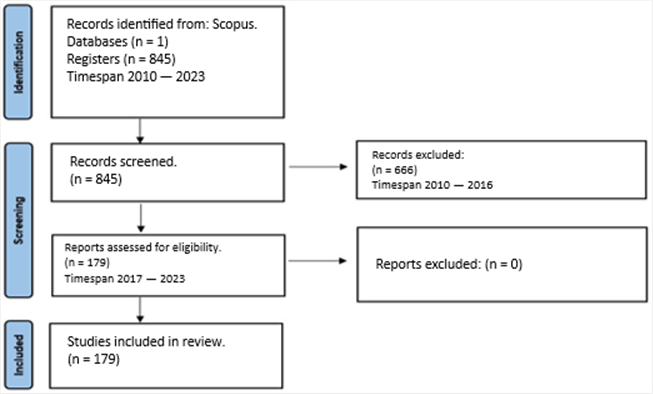
Figure
1.
Methodological process of bibliometric study
2.4. Data Organization and Analysis
Once the sample was obtained, the documents were organized and classified according to the following variables:
a) Year of publication.
b) Authors’ country of affiliation.
c) Area of knowledge.
d) Type of publication.
e) Keyword co-occurrence.
The data exported in CSV format were
cleaned and structured in Microsoft Excel 365, where incomplete records were
removed, and keywords were normalized.
Subsequently, bibliometric techniques were applied following the frameworks of
Aria and Cuccurullo (2017) and Zupic and Čater (2015), with emphasis on
productivity, impact, collaboration, and thematic interrelation analyses.
2.5. Tools and Software Used
Data processing and visualization were conducted using the following programs:
a) RStudio (version R 4.1.1) with the Bibliometrix package: analysis of annual productivity, leading authors, sources, and thematic areas (Aria & Cuccurullo, 2017).
b) VOSviewer (version 1.6.19): generation of keyword co-occurrence maps, co-authorship networks, and thematic clusters (van Eck & Waltman, 2010).
c) Microsoft Excel 365: initial data cleaning and tabular organization (Meyer & Avery, 2009).
These tools enabled the integration of quantitative analysis with visualizations that facilitate the interpretation of trends and patterns in literature. The methodological steps are summarized in Figure 2.
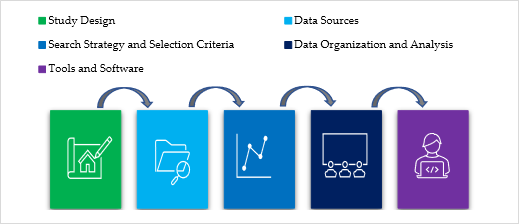
Figure 2. Methodological steps
3. Results
3.1. Keyword Co-Occurrences
The data from Figure 3, exported from Scopus, show the variables and their relationship with other terms. It is evident that marketing is related to digital marketing and is associated with social media, given that currently—and with an increasing trend—platforms like Facebook and Instagram are used in the application of marketing strategies. For this to work, the internet is a fundamental tool, as it benefits both companies and customers (Lamberton & Stephen, 2016).
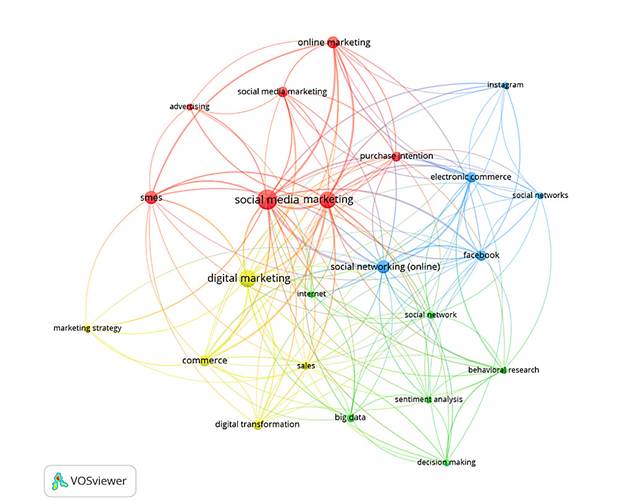
Figure 3. Keyword Co-Occurrences
3.2. Documents by Year of Publication
Figure 4 shows the scientific production related to the variables digital marketing, social media, and innovation during the period from 2017 to May 2023, totaling 179 documents published in Scopus. It can be observed that production increased each year. In 2017, six documents were published, followed by 11 in 2018, 23 in 2019, 27 in 2020, 44 in 2021, 46 in 2022, and 22 documents were published in the first few months of 2023.
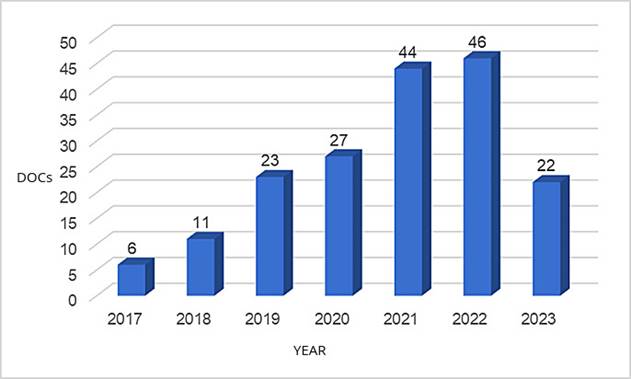
Figure 4. Documents by Year of Publication
Among the documents published in the year with the highest output, one article that addresses innovation is titled "Communication of Slovak Eco-Innovation Companies with Social Media Users." It refers to changes in current consumer behavior, which open space for innovating existing strategies. Communication is a key activity in any business seeking to sell its products or services. Social media platforms play a significant role in these strategies as tools for communication, awareness, interaction, and sales (Zaušková et al., 2022).
3.3. Documents by Country of Origin
Figure 5 shows how the scientific output is distributed according to the authors' countries, focusing on countries with five or more publications. India, the United Kingdom, and the United States had the highest number of publications (16 each), followed by Portugal with 14 documents, Spain with 13, China with 12, Italy with nine, Turkey with eight, the United Arab Emirates, Czech Republic, Germany, and Malaysia with seven, Slovakia and Australia with six, and Indonesia and Saudi Arabia with five.
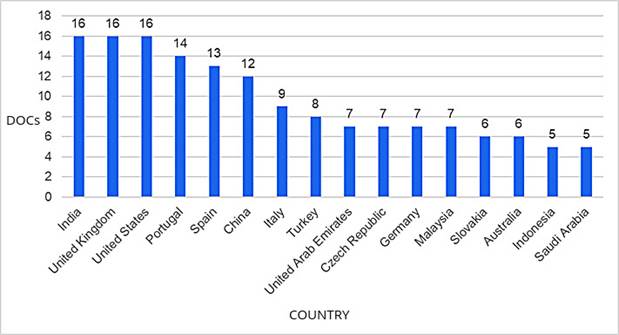
Figure 5. Documents by Country of Origin
The article "Creative Innovation in Relationship Marketing of Islamic Fashion E-Commerce in Indonesia," produced in Indonesia, mentions that to develop relationship marketing in e-commerce, creative innovation is needed—integrating both online and offline activities. The power of search and sharing on social media can be used as a tool for relationship marketing, aiming to show what the company is doing by managing these platforms. Additionally, customer conversations can be used to create brand stories that resonate with audiences (Purwaningwulan et al., 2019).
3.4. Documents by Knowledge Area
Figure 6 shows the percentage distribution of publications by field, through which various research methodologies are implemented to generate knowledge. Most of the publications found in the Scopus database come from business, management, and accounting sciences, followed at a considerable distance by economics, econometrics, and finance. These are followed by the social sciences, engineering, and others.
As can be seen, the variables in this research are relevant across multiple fields of knowledge, as they have a business impact. One of the published articles is titled "Digital Marketing Communication in Global Markets: A Review of Existing Research, Future Directions, and Potential Approaches." It points out that digital or electronic communication between businesses and consumers is growing rapidly, especially during the COVID-19 period. However, most of the research has been focused on national rather than global contexts, despite the transnational nature of digital marketing. Moreover, managers lack the competencies to standardize marketing strategies at the national level (Shankar et al., 2022).
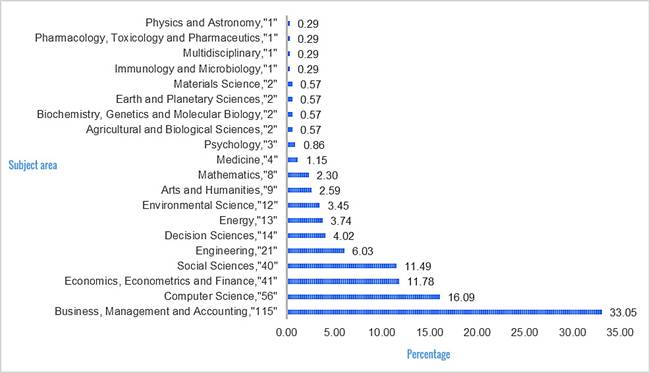
Figure 6. Documents by Knowledge Area
3.5. Types of Publications
Figure 7 shows that the predominant type of publication in the study of digital marketing, social media, and innovation is the journal article, accounting for 60.34% (108 documents), followed by book chapters at 13.97% (25 documents), reviews at 11.17% (20 documents), conference papers at 7.82% (14 documents), and books at 6.70% (12 documents).
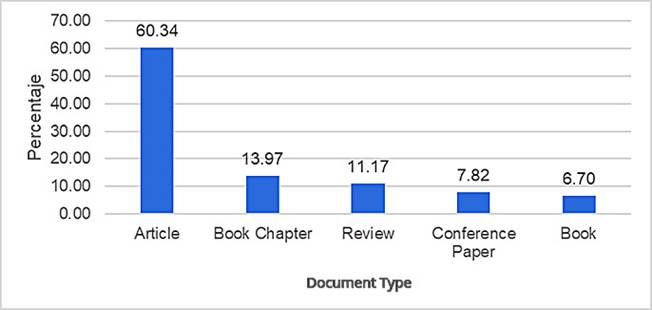
Figure 7. Output by Type of Publication
The published articles address the use of digital technologies in business. For instance, the emergence of blockchain technology is considered one of the most promising tools for marketing management (Wasiq et al., 2023). Furthermore, it is noted that the digital economy demands the development of new business models to achieve excellence in strategic marketing, especially given that half the world’s population is active on social media platforms (Travassos & Carmo, 2023).
4. Discussion and Conclusions
The aim of this study was to analyze the main characteristics, patterns, and trends in scientific production on digital marketing, social media, and innovation, based on literature indexed in Scopus between 2017 and May 2023. The results obtained through bibliometric techniques address the research question and provide a global overview of the evolution of this field, revealing relevant dynamics for both academia and the business environment.
4.1. Discussion of Results Based on the Objective
First, the findings show sustained growth in scientific production related to digital marketing on social media, rising from 6 publications in 2017 to a peak of 46 in 2022. This increase suggests that the topic has gained relevance over time, likely driven by accelerated digital transformation during and after the COVID-19 pandemic. The presence of 22 publications in the early months of 2023 further reinforces the idea of a still-expanding trend.
In terms of geographic distribution, India, the United Kingdom, and the United States stand out as the countries with the highest number of publications. This pattern aligns with reports by Appel et al. (2020) and Shankar et al. (2022), who highlight the rapid adoption of digital technologies in highly competitive business contexts. Furthermore, these countries possess a consolidated academic infrastructure that supports research on marketing innovation.
From a thematic perspective, the analysis by knowledge area revealed that the most involved disciplines were business, management, and accounting, followed by economics and social sciences. This outcome reaffirms the multidisciplinary nature of digital marketing, consistent with Krishen et al. (2021), who argue that this field requires integrative approaches that consider technological, social, and strategic dimensions.
Regarding the type of document, the predominance of scientific articles (60.34%) suggests academic consolidation of the topic and its formal inclusion in research agendas. The significant frequency of reviews, book chapters, and conference papers reinforces the idea that this is an evolving field, subject to conceptual debates and practical applications.
The co-occurrence maps showed that the most relevant keywords revolve around “digital marketing”, “social media”, “innovation”, and “consumer”, indicating that research focuses on the interaction between companies and users through digital platforms. However, the term “innovation” did not appear as strongly as expected, which may be attributed to how authors formulate their keywords, or to a conceptual disconnect between innovation and digital marketing in some studies. This finding partially aligns with observations by Jung and Shegai (2023), who acknowledge that innovation is not yet fully integrated into digital marketing research.
4.2. Comparison with the Reviewed Literature
Overall, the findings of this study complement and expand upon the contributions of previous research. While Wasiq et al. (2023) focused on the relationship between marketing and emerging technologies such as blockchain, and Amiri et al. (2023) analyzed dynamics within SMEs, this study adopts a broader and more descriptive perspective of the digital marketing ecosystem on social media. Likewise, unlike Krishen et al. (2021), who conducted an analysis centered on digital interactions, this study incorporates key bibliometric variables such as type of publication, thematic co-occurrence, and country distribution.
Conceptual similarities are also observed with authors such as Scuotto et al. (2017) and Ungerman et al. (2018), who emphasize the innovative potential of social media as marketing tools, especially in dynamic business environments. However, our study shows that such potential has yet to translate into more frequent use of “innovation” as a central descriptor in recent bibliographic studies, highlighting an opportunity to align theory and practice in future research.
4.3. Theoretical and Practical Implications
From a theoretical perspective, the results help to highlight the evolution of digital marketing as a field of study, identifying not only its disciplinary consolidation but also its conceptual gaps. This evidence may be useful in developing integrative theoretical frameworks that link digitalization, consumer behavior, organizational innovation, and network analysis.
Practically, this study provides key insights for marketing managers, digital strategists, and business decision-makers. Understanding research trends help guide the design of campaigns more aligned with scientific evidence, identify emerging practices, and anticipate changing scenarios. Moreover, the visualization of dominant keywords and themes allows consultants and professionals to detect focal points in academic discourse and apply them to corporate strategies.
4.4. Study Limitations
Among the main limitations is the exclusive reliance on the Scopus database, which may have excluded relevant publications indexed in Web of Science, Google Scholar, or regional databases. Additionally, using a single search formula and relying on author-provided keywords may have limited the breadth of the retrieved corpus. As mentioned earlier, the low appearance of “innovation” as a keyword may reflect a methodological weakness in the search criteria rather than an actual absence in the content of the documents.
Furthermore, although a qualitative document review of notable contributions is mentioned, it was not systematic nor followed interpretive coding criteria, so its findings should be interpreted with caution and not generalized.
4.5. Directions for Future Research
Based on these limitations, future studies are encouraged to:
1) Expand the analysis corpus by including other academic databases.
2) Refine search strategies by incorporating synonyms and more flexible Boolean operators.
3) Conduct deeper thematic analyses using systematic review methods or content analysis.
4) Explore the connections between digital marketing and innovation through mixed approaches that combine bibliometric metrics with expert interviews or case studies.
5) Analyze the role of specific platforms (e.g., TikTok, LinkedIn) in emerging digital marketing strategies.
In conclusion, this bibliometric study confirms the rise of digital marketing on social media as a growing, multidisciplinary research line with high application potential. However, it also reveals conceptual gaps that must be addressed to strengthen the connection between innovation and digital practices in business contexts. Understanding these patterns not only contributes to the academic agenda but also provides strategic tools for marketing management in the digital age.
Author Contributions: All contributions were carried out by Egidio Peixoto Rodríguez, including conceptualization, methodology, investigation, writing, and project administration. The author has read and agreed to the published version of the manuscript.
Funding: This research received no external funding.
Data Availability Statement: All data are included in this document.
Conflicts of Interest: The author declares no conflicts of interest.
References
Amiri, A. M., Kushwaha, B. P., & Singh, R. (2023). Visualisation of global research trends and future research directions of digital marketing in small and medium enterprises using bibliometric analysis. Journal of Small Business and Enterprise Development, 30(3), 621–641. https://doi.org/10.1108/JSBED-04-2022-0206
Ananda, A. S., Hernández-García, Á., & Lamberti, L. (2016). N-REL: A comprehensive framework of social media marketing strategic actions for marketing organizations. Journal of Innovation and Knowledge, 1(3), 170–180. https://doi.org/10.1016/j.jik.2016.01.003
Appel, G., Grewal, L., Hadi, R., & Stephen, A. T. (2020). The future of social media in marketing. Journal of the Academy of Marketing Science, 48(1), 79–95. https://doi.org/10.1007/s11747-019-00695-1
Aria, M., & Cuccurullo, C. (2017). bibliometrix: An R-tool for comprehensive science mapping analysis. Journal of Informetrics, 11(4), 959–975. https://doi.org/10.1016/j.joi.2017.08.007
Balogh, J. M., & Mizik, T. (2022). Impacts of Marketing Strategy and Social Media Activity on the Profitability of Online Wine Shops: The Case of Hungary. Economies, 10(12), 1–15. https://doi.org/10.3390/economies10120301
Burnham, J. F. (2006). Scopus database: A review. Biomedical Digital Libraries, 3, 1–9. https://doi.org/10.1186/1742-5581-3-1
Dearlove, T., Begley, A., Scott, J. A., & Devenish-Coleman, G. (2021). Digital marketing of commercial complementary foods in australia: An analysis of brand messaging. International Journal of Environmental Research and Public Health, 18(15). https://doi.org/10.3390/ijerph18157934
García, J. J. L., Lizcano, D., Ramos, C. M. Q., & Matos, N. (2019). Digital marketing actions that achieve a better attraction and loyalty of users: An analytical study. Future Internet, 11(6), 1–17. https://doi.org/10.3390/fi11060130
Gómez Sierra, C. J. (2020). Impact through digital marketing tools in social networks and web analytics in higher education institutions. IOP Conference Series: Materials Science and Engineering, 844(1). https://doi.org/10.1088/1757-899X/844/1/012050
Habibi, F., Hamilton, C. A., Valos, M. J., & Callaghan, M. (2015). E-marketing orientation and social media implementation in B2B marketing. In European Business Review (Vol. 27, Issue 6). https://doi.org/10.1108/EBR-03-2015-0026
Herhausen, D., Miočević, D., Morgan, R. E., & Kleijnen, M. H. P. (2020). The digital marketing capabilities gap. Industrial Marketing Management, 90(2020), 276–290. https://doi.org/10.1016/j.indmarman.2020.07.022
Jung, S. U., & Shegai, V. (2023). The Impact of Digital Marketing Innovation on Firm Performance: Mediation by Marketing Capability and Moderation by Firm Size. Sustainability (Switzerland), 15(7), 1–16. https://doi.org/10.3390/su15075711
Khan, S. (2021). Structural framework of digital transformation enablers towards enhancing the social media marketing. Management Science Letters, 11(2), 327–338. https://doi.org/10.5267/j.msl.2020.9.037
Klepek, M., & Starzyczná, H. (2018). Marketing communication model for social networks. Journal of Business Economics and Management, 19(3), 500–520. https://doi.org/10.3846/jbem.2018.6582
Krishen, A. S., Dwivedi, Y. K., Bindu, N., & Kumar, K. S. (2021). A broad overview of interactive digital marketing: A bibliometric network analysis. Journal of Business Research, 131(February 2020), 183–195. https://doi.org/10.1016/j.jbusres.2021.03.061
Lamberton, C., & Stephen, A. T. (2016). A thematic exploration of digital, social media, and mobile marketing: Research evolution from 2000 to 2015 and an agenda for future inquiry. Journal of Marketing, 80(6), 146–172. https://doi.org/10.1509/jm.15.0415
Low, S., Ullah, F., Shirowzhan, S., Sepasgozar, S. M. E., & Lee, C. L. (2020). Smart digital marketing capabilities for sustainable property development: A case of Malaysia. Sustainability (Switzerland), 12(13), 1–40. https://doi.org/10.3390/su12135402
Mazerant, K., Willemsen, L. M., Neijens, P. C., & van Noort, G. (2021). Spot-On Creativity: Creativity Biases and Their Differential Effects on Consumer Responses in (Non-)Real-Time Marketing. Journal of Interactive Marketing, 53, 15–31. https://doi.org/10.1016/j.intmar.2020.06.004
Meyer, D. Z., & Avery, L. M. (2009). Excel as a qualitative data analysis tool. Field Methods, 21(1), 91–112. https://doi.org/10.1177/1525822X08323985
Palaniswamy, V., & Raj, K. (2022). SOCIAL MEDIA MARKETING ADOPTION BY AGRICULTURISTS: A TAM BASED STUDY. International Journal of Professional Business Review, V7(3), 1–14. https://doi.org/10.26668/businessreview/2022.v7i3.0537
Păvăloaia, V. D., Anastasiei, I. D., & Fotache, D. (2020). Social media and e-mail marketing campaigns: Symmetry versus convergence. Symmetry, 12(12), 1–23. https://doi.org/10.3390/sym12121940
Purwaningwulan, M. M., Suryana, A., Wahyudin, U., & Dida, S. (2019). Creative innovation online relationship marketing Islamic fashion e-commerce in Indonesia. Library Philosophy and Practice, 2019. https://www.scopus.com/pages/publications/85066083917
Saura, J. R., Palos-Sánchez, P., & Cerdá Suárez, L. M. (2017). Understanding the Digital Marketing Environment with KPIs and Web Analytics. Future Internet, 9(76), 1–13. https://doi.org/10.3390/fi9040076
Scuotto, V., Del Giudice, M., & Carayannis, E. G. (2017). The effect of social networking sites and absorptive capacity on SMES’ innovation performance. Journal of Technology Transfer, 42(2), 409–424. https://doi.org/10.1007/s10961-016-9517-0
Shankar, V., Grewal, D., Sunder, S., Fossen, B., Peters, K., & Agarwal, A. (2022). Digital marketing communication in global marketplaces: A review of extant research, future directions, and potential approaches. International Journal of Research in Marketing, 39(2), 541–565. https://doi.org/10.1016/j.ijresmar.2021.09.005
Shankar, V., Kleijnen, M., Ramanathan, S., Rizley, R., Holland, S., & Morrissey, S. (2016). Mobile Shopper Marketing: Key Issues, Current Insights, and Future Research Avenues. Journal of Interactive Marketing, 34(1), 37–48. https://doi.org/10.1016/j.intmar.2016.03.002
Tarazona-Montoya, R., Peris-Ortiz, M., & Devece, C. (2020). The value of cluster association for digital marketing in tourism regional development. Sustainability (Switzerland), 12(23), 1–18. https://doi.org/10.3390/su12239887
Travassos, A., & Carmo, J. (2023). Marketing Strategies on Social Media Platforms. International Journal of E-Business Research, 19(1), 1–25. https://doi.org/10.4018/IJEBR.316969
Ungerman, O., Dedkova, J., & Gurinova, K. (2018). The impact of marketing innovation on the competitiveness of enterprises in the context of industry 4.0. Journal of Competitiveness, 10(2), 132–148. https://doi.org/10.7441/joc.2018.02.09
van Eck, N. J., & Waltman, L. (2010). Software survey: VOSviewer, a computer program for bibliometric mapping. Scientometrics, 84(2), 523–538. https://doi.org/10.1007/s11192-009-0146-3
Wasiq, M., Bashar, A., Akmal, S., Rabbani, M. R., Saifi, M. A., Nawaz, N., & Nasef, Y. T. (2023). Adoption and Applications of Blockchain Technology in Marketing: A Retrospective Overview and Bibliometric Analysis. Sustainability (Switzerland), 15(4), 1–20. https://doi.org/10.3390/su15043279
Winarso, W., Sinaga, J., Syarief, F., Untari, D. T., Supardi, & Mulyadi. (2023). The impact of social media and innovation strategy on the marketing performance of small and medium sized enterprises (SMEs) in Bekasi City, Indonesia. International Journal of Professional Business Review, 8(5), 1–14. https://doi.org/10.26668/businessreview/2023.v8i5.1688
Yarney, F., Moreno, R., Augusto Sanchez Martelo, C., Yeet, B., Corredor, A., Fernando, J., Cifuentes, S., Pablo, J., & López, O. (2020). Técnicas para la Clasificación de Sentimientos en Redes Sociales como Apoyo en el Marketing Digital. Revista Ibérica de Sistemas e Tecnologias de Informação, 167–187. https://www.proquest.com/scholarly-journals/técnicas-para-la-clasificación-de-sentimientos-en/docview/2453792431/se-2
Zaušková, A., Ščepková, S., & Kubovics, M. (2022). Communication of Slovak Eco-innovation Companies with Social Media Users. 9th European Conference on Social Media, ECSM 2022, 2016, 219–227. https://doi.org/10.34190/ecsm.9.1.191
Zupic, I., & Čater, T. (2015). Bibliometric Methods in Management and Organization. Organizational Research Methods, 18(3), 429–472. https://doi.org/10.1177/1094428114562629
Disclaimer/Publisher’s Note: The statements, opinions, and data contained in all publications are solely those of the individual authors and contributors, and do not necessarily reflect those of Ceniiac Journal of Negocios Globales, its publisher, or the editors. Neither the journal, the publisher, nor the editors assume responsibility for any harm to people or property resulting from the use of any ideas, methods, instructions, or products mentioned in the content.